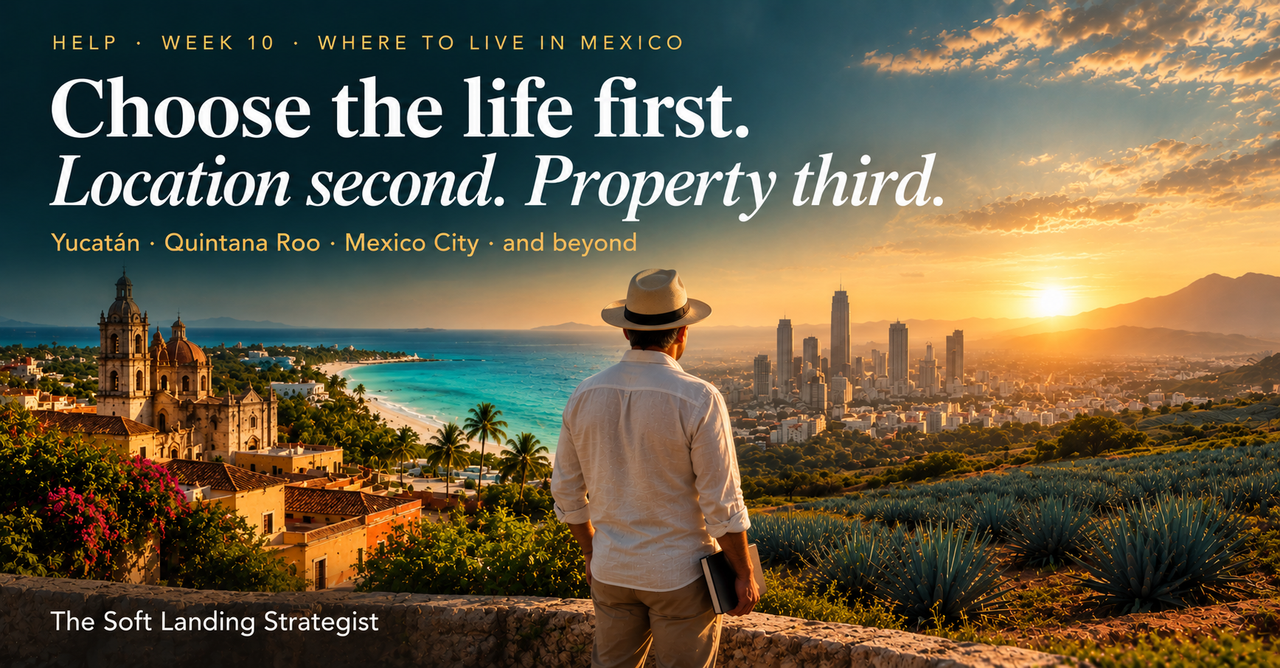
¿Dónde Deberías Vivir en México? Yucatán, Quintana Roo, CDMX y Más
Where Should You Live in Mexico? Yucatán, Quintana Roo, Mexico City and Beyond
Estimado lector:
Cierra los ojos por un momento e imagina despertar en México.
Quizás escuchas pájaros por la mañana y hueles café que flota por una calle colonial en Yucatán. O quizás estás sentado en una terraza cerca del Caribe, con el sonido del mar afuera. O tal vez lo que quieres es algo completamente diferente: museos, galerías, restaurantes, conexiones internacionales y la energía de una gran ciudad.
Todas estas experiencias son México. Y es precisamente por eso que elegir dónde vivir puede ser más difícil de lo que parece a primera vista.
México no es un solo mercado. Es una colección de regiones, ciudades, climas, economías y estilos de vida muy diferentes. Para alguien que considera jubilarse, mudarse o invertir, la pregunta no debería ser “¿cuál es el mejor lugar para vivir en México?”, sino:
“¿Cuál lugar es mejor para la vida y los objetivos que estoy tratando de construir?”
El error que veo cometer a la gente
Internet hace muy fácil enamorarse de un lugar. Una fotografía hermosa. Un condominio frente al mar. Una casa colonial en Mérida. Un apartamento sofisticado en la Ciudad de México. Entonces alguien dice: “Este es el lugar donde todos están comprando.” Ahí es cuando recomiendo ir más despacio.
El lugar perfecto para unas vacaciones de dos semanas puede ser completamente equivocado para una jubilación de veinte años. La ciudad que funciona maravillosamente para un joven emprendedor puede no ser la elección correcta para un jubilado. Y el destino que parece atractivo para generar ingresos por alquiler puede tener consideraciones muy diferentes de una propiedad destinada a convertirse en tu hogar.
La ubicación debe seguir al propósito. No a la publicidad. No a la moda. No al sueño de otra persona.
Cuatro experiencias muy diferentes de México
Yucatán — Mérida y la costa
Yucatán puede ser particularmente atractivo para personas que buscan un ritmo más lento, carácter colonial, acceso a la costa y una comunidad internacional en crecimiento. Mérida también ofrece atención médica privada establecida, restaurantes, actividades culturales y una economía de servicios en expansión. Pero Yucatán no es un solo estilo de vida: vivir en el centro de Mérida es muy diferente de vivir en una comunidad costera. La elección correcta depende de lo que realmente quieres de la vida cotidiana.
Quintana Roo — Cancún, Playa del Carmen y Tulum
Aquí el Caribe es una parte importante de la ecuación. El turismo, la conectividad internacional, la hospitalidad y una gran presencia de expatriados crean un entorno muy diferente. Para algunas personas, eso es exactamente lo que quieren. Para otras, la intensidad turística, el tráfico, la actividad estacional y los patrones de desarrollo pueden hacer que otra región sea más apropiada. De nuevo, el municipio no es suficiente información: el vecindario importa, la propiedad específica importa y el uso previsto importa.
Ciudad de México — la opción metropolitana
La Ciudad de México ofrece algo que los destinos costeros no pueden reproducir fácilmente: escala. La actividad corporativa, la cultura, las universidades, los servicios médicos especializados, los restaurantes, los museos, las galerías y las conexiones internacionales crean un entorno urbano diferente al de la mayoría de las otras ciudades mexicanas. Para alguien cuya vida o negocio depende de un ecosistema metropolitano importante, la CDMX puede tener mucho sentido. Para alguien que busca mañanas tranquilas y un ritmo más lento, quizás no.
El Bajío y el Occidente de México
Querétaro, Guadalajara y otras ciudades de la región ofrecen otra propuesta. Estos mercados están conectados a la manufactura, la tecnología, los servicios profesionales y un desarrollo económico más amplio. Para emprendedores y profesionales cuyas prioridades involucran operaciones de negocio en lugar de jubilarse junto al mar, merecen una consideración seria.
La pregunta que haría antes de elegir cualquiera de ellos
No preguntes “¿cuál ciudad es más segura?”. No preguntes “¿dónde están comprando los extranjeros?”. Y no preguntes “¿dónde se apreciará más la propiedad?”. Pregunta esto en su lugar:
- ¿Cómo será mi vida diaria?
- ¿De dónde vendrán mis ingresos?
- ¿Con qué frecuencia viajaré internacionalmente?
- ¿Qué atención médica necesito?
- ¿Necesito un centro de negocios importante cerca?
- ¿Quiero turismo, cultura, tranquilidad —o alguna combinación?
- ¿Estoy comprando un hogar, una inversión, o ambos?
Esas preguntas eliminarán muchas ubicaciones antes de que siquiera visites una propiedad. Y eso puede ahorrarte tiempo y dinero considerables.
La cuestión costera que los compradores extranjeros deben entender
También hay un tema legal que debe abordarse temprano. Si eres un comprador extranjero que considera una propiedad cerca de la costa de México o las fronteras internacionales, determina si la propiedad cae dentro de la zona restringida. La Constitución establece restricciones que involucran tierras dentro de los 50 kilómetros de la costa y 100 kilómetros de las fronteras.
Para propiedades residenciales en la zona restringida, los compradores extranjeros comúnmente usan un fideicomiso bancario. Otras estructuras pueden ser apropiadas en circunstancias diferentes, particularmente para ciertas inversiones no residenciales. Pero no hay una respuesta universal. La estructura legal debe seguir a la propiedad y al propósito. No al revés.
No dejes que la propiedad elija la ciudad por ti
Este es uno de los principios que más me gustaría que los compradores extranjeros recordaran. Una propiedad hermosa puede crear impulso emocional. Caminas hacia la terraza. Ves la piscina. Imaginas tu jubilación. Ya puedes imaginarte a tu familia visitando. Y de repente estás tomando una decisión sobre la propiedad antes de haber tomado la decisión más grande sobre la ubicación.
Considera un ejemplo simple
Imagina a un consultor canadiense eligiendo entre un condominio en Playa del Carmen y una propiedad colonial en Mérida. Ambos se ven atractivos. Ambos podrían potencialmente funcionar. Pero supongamos que sus prioridades son:
- pasar la mayor parte del año en México;
- continuar trabajando de forma remota;
- tener acceso a actividades culturales y servicios establecidos;
- vivir a un ritmo más lento;
- y estar dentro de un alcance razonable de un aeropuerto internacional.
Esas prioridades pueden apuntarlo hacia una decisión diferente a la de alguien cuyo objetivo principal es el ingreso por alquiler vacacional a corto plazo. Mismo país. Mismo comprador. Diferente objetivo. Diferente respuesta.
Por eso me resisto a la idea de que hay un solo “mejor” lugar en México. El agente inmobiliario responde “¿Dónde?”. El estratega pregunta “¿Por qué?”.
Después de más de cuatro décadas trabajando con inversionistas y emprendedores, y más de 25 años asesorando a extranjeros en México, esta es una de las distinciones más importantes que he aprendido. Una propiedad no es solo una dirección. Es parte de una decisión más grande que involucra estilo de vida, ingresos, atención médica, movilidad, impuestos, estructura legal, familia y planes a largo plazo. La ubicación correcta es la que hace que esas piezas funcionen juntas.
Antes de elegir tu ciudad mexicana, haz esto
Toma una hoja de papel y escribe cinco cosas:
- La vida que quiero vivir.
- Los ingresos o recursos que tendré disponibles.
- Los servicios en los que no puedo comprometer.
- El papel que México jugará —hogar, negocio, inversión, o alguna combinación.
- Cuánto tiempo espero quedarme.
Luego compara ubicaciones. No fotografías. Ubicaciones. No promesas. Condiciones reales.
México no tiene un solo lugar perfecto. Y eso es una buena noticia: significa que hay una muy buena probabilidad de que en algún lugar de este extraordinariamente diverso país haya un lugar que se ajuste a tus objetivos. El desafío es encontrarlo antes de comprar.
Entiende primero. Elige la región segundo. Evalúa la propiedad tercero. Estructura la transacción cuarto. Ese es el comienzo de un verdadero Soft Landing.
Si quieres explorar el marco más amplio de 8 pasos que uso cuando ayudo a personas a invertir, vivir y construir un futuro en México, puedes encontrar ¿Opción? ¡México! en Amazon México: https://www.amazon.com.mx/dp/B0FT619M4R
Esta publicación proporciona información general y no es un sustituto de asesoría legal, fiscal, migratoria, financiera o de inversión individualizada. Las circunstancias específicas deben revisarse con los profesionales calificados apropiados.
Con cariño,
Miguel Angel Sosa Chable
The Soft Landing Strategist
Dear reader,
Close your eyes for a moment and imagine waking up in Mexico.
Perhaps you hear birds in the morning and smell coffee drifting down a colonial street in Yucatán. Or perhaps you are sitting on a terrace near the Caribbean, with the sound of the sea outside. Or perhaps what you want is something completely different: museums, galleries, restaurants, international connections, and the energy of a major city.
All of these experiences are Mexico. And that is precisely why choosing where to live can be harder than it first appears.
Mexico is not a single market. It is a collection of regions, cities, climates, economies, and lifestyles that are very different from one another. For someone considering retirement, relocation, or investment, the question shouldn't be “What is the best place to live in Mexico?” It should be:
“Which place is best for the life and goals I am trying to build?”
The mistake I see people make
The internet makes it very easy to fall in love with a place. A beautiful photograph. An oceanfront condo. A colonial house in Mérida. A sophisticated apartment in Mexico City. Then someone says: “This is where everyone is buying.” That is when I recommend slowing down.
The perfect place for a two-week vacation can be completely wrong for a twenty-year retirement. The city that works wonderfully for a young entrepreneur may not be the right choice for a retiree. And a destination that looks attractive for rental income can carry very different considerations from a property meant to become your home.
Location should follow purpose. Not advertising. Not fashion. Not someone else's dream.
Four very different experiences of Mexico
Yucatán — Mérida and the coast
Yucatán can be particularly appealing to people looking for a slower pace, colonial character, access to the coast, and a growing international community. Mérida also offers established private healthcare, restaurants, cultural activities, and an expanding service economy. But Yucatán is not a single lifestyle: living in downtown Mérida is very different from living in a coastal community. The right choice depends on what you actually want from daily life.
Quintana Roo — Cancún, Playa del Carmen, and Tulum
Here the Caribbean is a major part of the equation. Tourism, international connectivity, hospitality, and a large expat presence create a very different environment. For some people, that is exactly what they want. For others, the tourist intensity, traffic, seasonal activity, and development patterns may make another region more appropriate. Again, the municipality is not enough information: the neighborhood matters, the specific property matters, and the intended use matters.
Mexico City — the metropolitan option
Mexico City offers something coastal destinations cannot easily replicate: scale. Corporate activity, culture, universities, specialized medical services, restaurants, museums, galleries, and international connections create an urban environment unlike most other Mexican cities. For someone whose life or business depends on a major metropolitan ecosystem, it can make a great deal of sense. For someone seeking quiet mornings and a slower pace, perhaps not.
The Bajío and Western Mexico
Querétaro, Guadalajara, and other cities in the region offer yet another proposition. These markets are connected to manufacturing, technology, professional services, and broader economic development. For entrepreneurs and professionals whose priorities involve business operations rather than retiring by the sea, they deserve serious consideration.
The questions I would ask before choosing any of them
Don't ask “Which city is safest?” Don't ask “Where are foreigners buying?” And don't ask “Where will property appreciate the most?” Ask this instead:
- What will my daily life look like?
- Where will my income come from?
- How often will I travel internationally?
- What healthcare do I need?
- Do I need a major business center nearby?
- Do I want tourism, culture, tranquility —or some combination?
- Am I buying a home, an investment, or both?
Those questions will eliminate many locations before you even visit a property. And that can save you considerable time and money.
The coastal issue foreign buyers should understand
There is also a legal topic that should be addressed early. If you are a foreign buyer considering property near Mexico's coast or international borders, determine whether the property falls within the restricted zone. The Constitution establishes restrictions involving land within 50 kilometers of the coast and 100 kilometers of the borders.
For residential property in the restricted zone, foreign buyers commonly use a bank trust, known as a fideicomiso. Other structures may be appropriate in different circumstances, particularly for certain non-residential investments. But there is no universal answer. The legal structure should follow the property and the purpose. Not the other way around.
Don't let the property choose the city for you
This is one of the principles I most wish foreign buyers would remember. A beautiful property can create emotional momentum. You walk onto the terrace. You see the pool. You imagine your retirement. You can already picture your family visiting. And suddenly you are making a decision about the property before you have made the bigger decision about the location.
Consider a simple example
Imagine a Canadian consultant choosing between a condo in Playa del Carmen and a colonial property in Mérida. Both look attractive. Both could potentially work. But suppose his priorities are:
- spending most of the year in Mexico;
- continuing to work remotely;
- having access to cultural activities and established services;
- living at a slower pace;
- and being within reasonable reach of an international airport.
Those priorities may point him toward a different decision than someone whose primary goal is short-term vacation rental income. Same country. Same buyer. Different goal. Different answer.
That is why I resist the idea that there is a single “best” place in Mexico. The real estate agent answers “Where?” The strategist asks “Why?”
After more than four decades working with investors and entrepreneurs, and more than 25 years advising foreigners in Mexico, this is one of the most important distinctions I have learned. A property is not just an address. It is part of a larger decision that involves lifestyle, income, healthcare, mobility, taxes, legal structure, family, and long-term plans. The right location is the one that makes those pieces work together.
Before you choose your Mexican city, do this
Take a sheet of paper and write down five things:
- The life I want to live.
- The income or resources I will have available.
- The services I cannot compromise on.
- The role Mexico will play —home, business, investment, or some combination.
- How long I expect to stay.
Then compare locations. Not photographs. Locations. Not promises. Real conditions.
Mexico does not have one perfect place. And that is good news: it means there is a very good chance that somewhere in this extraordinarily diverse country, there is a place that fits your goals. The challenge is finding it before you buy.
Understand first. Choose the region second. Evaluate the property third. Structure the transaction fourth. That is the beginning of a true Soft Landing.
If you would like to explore the broader 8-step framework I use when helping people invest, live, and build a future in Mexico, you can find ¿Opción? ¡México! on Amazon: https://www.amazon.com.mx/dp/B0FT619M4R
This publication provides general information and is not a substitute for individualized legal, tax, immigration, financial, or investment advice. Specific circumstances should be reviewed with the appropriate qualified professionals.
Warmly,
Miguel Angel Sosa Chable
The Soft Landing Strategist
Real estate advisory across Mexico, with regional expertise in Yucatan.
Comentarios
Publicar un comentario