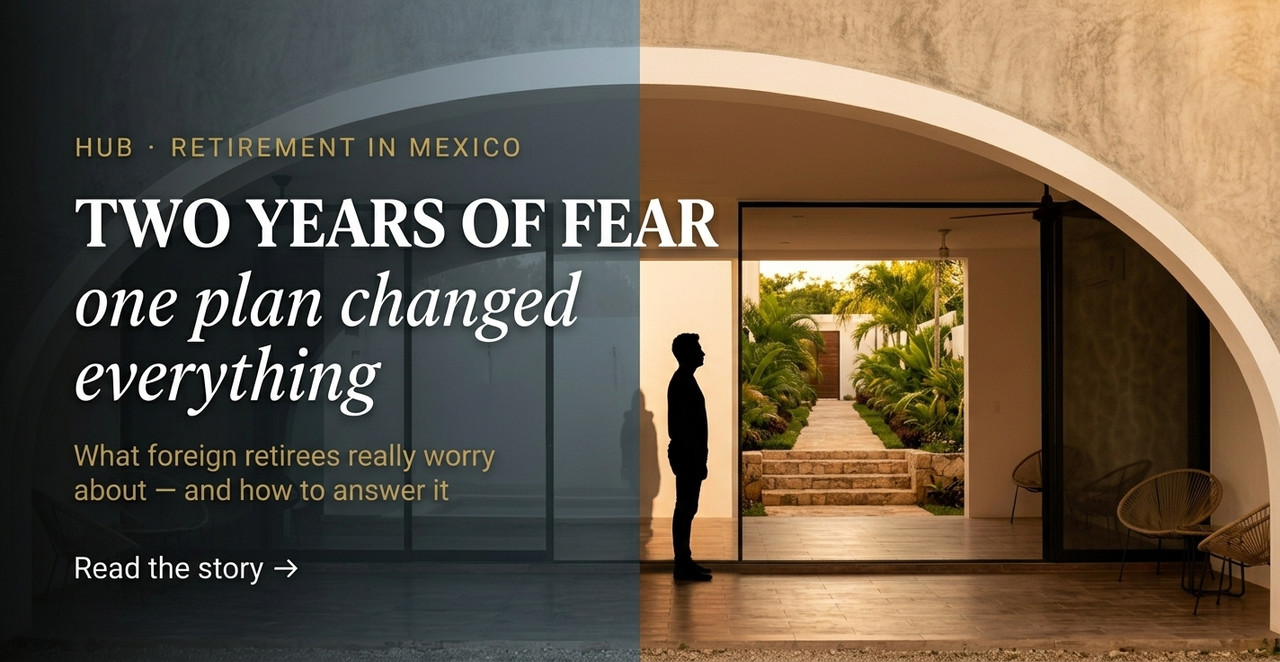
Los Dos Años que Pasó con Miedo de Jubilarse en México
The Two Years He Spent Afraid to Retire in Mexico
Querido lector:
Hace unas semanas hablé con un jubilado canadiense que llevaba apenas tres meses viviendo en una tranquila comunidad de Yucatán. Me contó algo que he escuchado muchas veces antes: antes de subir al avión, había pasado casi dos años preocupado. No por el calor. No por el idioma.
Sus verdaderas preocupaciones eran mucho más prácticas: ¿qué pasa si me enfermo? ¿qué pasa con mis ahorros si cometo un error con los trámites? ¿México realmente es tan seguro y accesible como dice la gente?
No son preguntas sin fundamento. Después de más de 40 años en el ámbito financiero y más de 25 años asesorando a familias y jubilados extranjeros en México, he aprendido que el miedo a jubilarse en otro país rara vez surge de un solo problema. Surge de no saber qué viene después.
Los tres temores que escucho con mayor frecuencia
1. “¿Y qué pasa con la atención médica?”
Muchos jubilados temen que dejar su país de origen signifique también dejar atrás el sistema de salud que conocen. México cuenta con un importante sector de atención médica privada, con hospitales modernos y médicos especialistas, y costos que pueden ser considerablemente diferentes de los de Estados Unidos o Canadá. Pero no existe un precio universal: las necesidades de salud, la cobertura del seguro, la ubicación y las circunstancias personales son factores que deben tomarse en cuenta. Investigue antes de mudarse; lo importante es no dar nada por sentado.
2. “¿Realmente puedo proteger mi propiedad?”
Los compradores extranjeros suelen escuchar que no pueden ser propietarios de inmuebles en las zonas costeras y fronterizas restringidas de México, y llegan a pensar que su inversión será menos segura. Pero así no funciona el sistema: la legislación mexicana contempla estructuras establecidas para la propiedad extranjera, incluido el fideicomiso bancario para propiedades residenciales en la zona restringida. Para ciertas situaciones empresariales o de inversión, una sociedad mexicana debidamente estructurada también puede ser apropiada. La clave no está en un atajo, sino en elegir la estructura correcta antes de comprometer su dinero.
3. “¿Mi dinero seguirá alcanzándome?”
Esta quizá sea la pregunta más personal de todas. Un ingreso de jubilación cómodo en un país puede producir un estilo de vida muy diferente en otro. México puede ofrecer costos más bajos en vivienda, alimentación y ciertos servicios privados, pero la diferencia depende enormemente de dónde y cómo viva. Yucatán no tiene un solo nivel de precios. Tampoco lo tienen Quintana Roo o la Ciudad de México. Tampoco Canadá. Tampoco Estados Unidos. Por eso prefiero hablar de poder adquisitivo, en lugar de prometer un porcentaje de ahorro.
Jubilarse no debería ser un salto hacia lo desconocido
El jubilado canadiense que mencioné finalmente tomó su decisión. Lo que cambió su perspectiva no fue un discurso de ventas: fue la información. Una vez que comprendió la secuencia —cómo evaluar la ubicación, verificar la propiedad, establecer la estructura legal adecuada, atender los requisitos migratorios y organizar la parte financiera—, la decisión dejó de parecerle tan aterradora.
Su propósito es sencillo: ayudar a un jubilado o inversionista extranjero a comprender qué debe hacerse y en qué orden antes de tomar una decisión que puede cambiar su vida —ya sea que ese cambio lo lleve a Yucatán o a cualquier otra parte de México.
La jubilación es la recompensa por décadas de trabajo. Si México forma parte de su futuro, merece algo más que un impulso. Merece una estrategia.
Si está considerando jubilarse en México, ¿cuál es la pregunta que todavía le hace dudar? Me gustaría sinceramente conocerla.
Un cordial saludo,
Miguel Angel Sosa Chable
The Soft Landing Strategist
Dear reader,
A few weeks ago, I spoke with a Canadian retiree who had been living for only three months in a quiet community in Yucatán. He told me something I have heard many times before: before getting on the plane, he had spent almost two years worrying. Not about the heat. Not about the language.
His real concerns were much more practical: What happens if I get sick? What happens to my savings if I make a mistake with the paperwork? Is Mexico really as safe and affordable as people say?
Those are not unreasonable questions. After more than 40 years in finance and more than 25 years advising foreign families and retirees in Mexico, I have learned that the fear of retirement abroad rarely comes from one single problem. It comes from not knowing what happens next.
The three fears I hear most often
1. “What about healthcare?”
Many retirees worry that leaving their home country means leaving behind the healthcare system they know. Mexico has a substantial private healthcare sector, including modern hospitals and specialist physicians, and costs that can be considerably different from those in the United States or Canada. But there is no universal price tag. Healthcare needs, insurance coverage, location, and personal circumstances all matter. Investigate before you move —the important point is not to assume.
2. “Can I actually protect my property?”
Foreign buyers often hear that they cannot own property in Mexico's restricted coastal and border zones and assume that their investment will somehow be less secure. That is not how the system works: Mexican law provides established structures for foreign ownership, including the fideicomiso bancario for residential property in the restricted zone. For certain business or investment situations, a properly structured Mexican company may also be appropriate. The key is not finding a shortcut —it is choosing the correct structure before committing your money.
3. “Will my money still go far enough?”
This may be the most personal question of all. A retirement income that feels comfortable in one country can produce a very different lifestyle somewhere else. Mexico can offer lower costs in several categories, including housing, food, and certain private services, but the difference depends enormously on where you live and how you live. Yucatán is not one single price point. Neither is Quintana Roo. Neither is Mexico City. Neither is Canada. Neither is the United States. That is why I prefer to talk about purchasing power, rather than promising a particular percentage of savings.
Retirement should not be a leap into the unknown
The Canadian retiree I mentioned earlier eventually made his decision. What changed his mind was not a sales pitch. It was information. Once he understood the sequence —how to evaluate the location, verify the property, establish the appropriate legal structure, address immigration requirements, and organize the financial side— the decision became much less frightening.
The purpose is simple: to help a foreign retiree or investor understand what should be done, and in what order, before making a life-changing move —whether that move leads to Yucatán or somewhere else in Mexico.
Retirement is the reward for decades of work. If Mexico is part of your future, it deserves more than an impulse. It deserves a strategy.
If you are considering retiring in Mexico, what is the one question that still makes you hesitate? I would genuinely like to hear it.
Warmly,
Miguel Angel Sosa Chable
The Soft Landing Strategist
Real estate advisory across Mexico, with regional expertise in Yucatan.
Comentarios
Publicar un comentario