Nearshoring: What It Is —
and How It Benefits You
“In professional investing, you don’t pay for what a country is today — you pay for the direction it’s heading. Mexico’s direction is straight up.”
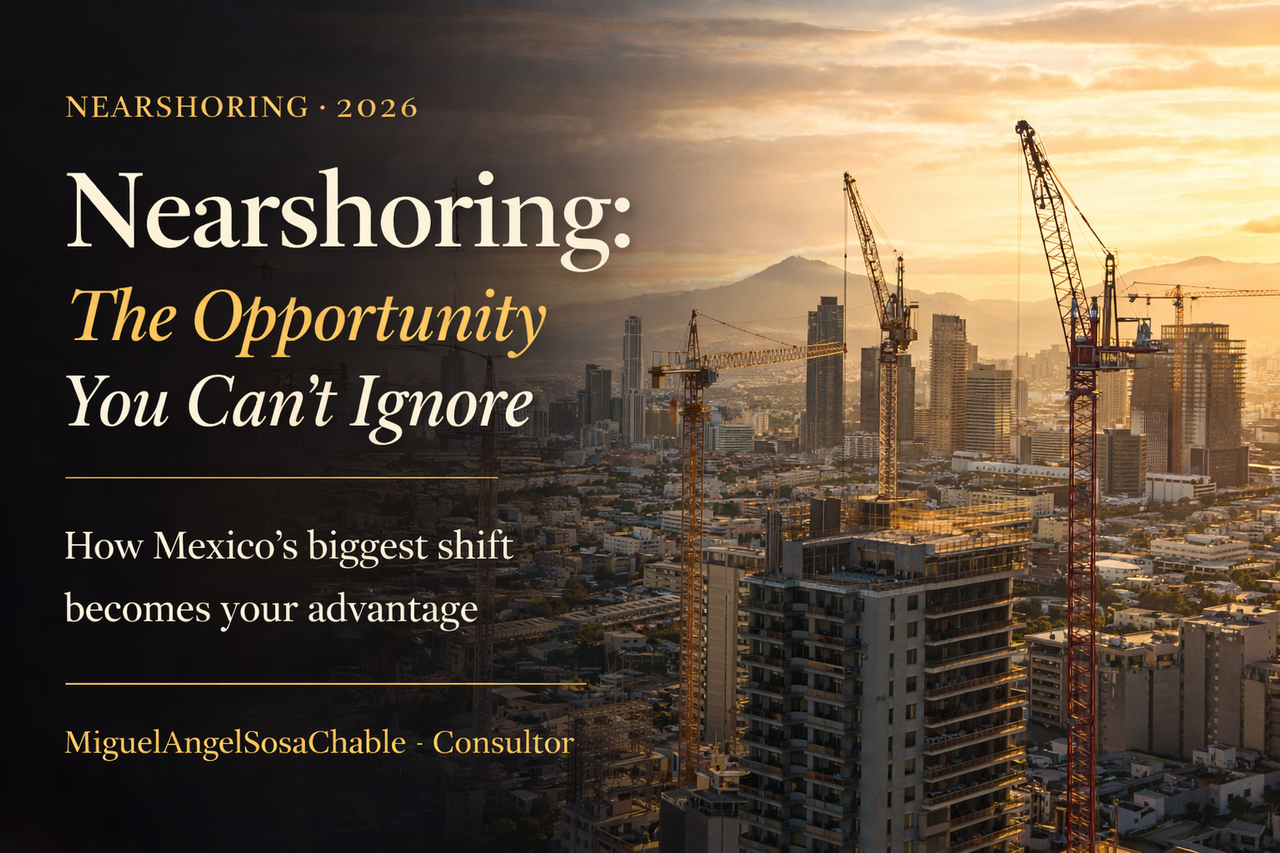
Close your eyes and listen. The rhythmic thud of hammers in the distance. Cranes transforming the skyline of Querétaro and Monterrey. The smell of freshly turned earth in a new residential development in northern Mérida. This is not a tourist brochure. This is the heartbeat of a country that has stopped waiting for the future and started building it — today, in June 2026.
For years, you may have watched Mexico from the sidelines. You heard whispers of the “Mexican Moment” at business dinners. But skepticism held you back. You feared volatility, waited for the “perfect” exchange rate, or simply assumed you’d arrived too late. Now, watching the global economy shift, you feel it: the window of opportunity has begun to narrow.
Here is the reality check: 2026 is not just the “best” year to invest in Mexico — for many, it will be the last year to enter with a significant competitive advantage.
So what exactly is nearshoring? It is the massive relocation of global manufacturing to Mexican soil — driven by the need to be close to U.S. and Canadian markets. Not just factories: a massive influx of capital, infrastructure, and a growing middle class hungry for services, housing, and quality of life. Mexico has spent decades positioning itself for this moment. 2026 is its boiling point.
84% of bilateral trade between Mexico, the U.S. and Canada moves under treaty protection. Not a bet — a legal certainty backed by international law.
Establishing your presence in Mexico can reduce operating costs by 50% to 60% compared to the U.S. or Western Europe. From day one.
A young, bilingual, highly skilled workforce driving technology and services. Your dollar commands 20%–30% more purchasing power here than in most developed markets.
A small European technology firm relocated its development team to Mexico in early 2025. By June 2026: operating costs reduced by 45%, founders with permanent residency, living in Mérida at a cost of life 60% lower than Paris or London. They didn’t just relocate a business — they upgraded a life.
The uncomfortable truth: the “safety” you feel keeping capital in your home market is often an illusion sustained by inflation. While you hesitate, your savings erode. In Mexico, your dollar commands significantly more purchasing power. You are losing money simply by standing still.
If you wait another year, premium properties in Yucatán — today the safest state in Mexico, with crime rates comparable to Western Europe — will be out of reach. The soft-landing advantages that exist today may close. You will look back at 2026 as the year you could have secured your family’s future at a fraction of today’s cost.
Nearshoring is the context. Your strategy is what determines your real benefit. Stop being a spectator. The 8-step roadmap is ready. Are you?
Sosa Chable
Rosado Sánchez
Nearshoring: qué es
y cómo le beneficia
“En inversión profesional, usted no paga por lo que un país es hoy — paga por la dirección hacia la que se dirige. Y la dirección de México es verticalmente hacia arriba.”
Cierre los ojos y escuche. El golpe rítmico de los martillos a lo lejos. Las grúas transformando el horizonte de Querétaro y Monterrey. El olor a tierra recién removida en un nuevo desarrollo en el norte de Mérida. Esto no es un folleto turístico; es el latido de un país que ha dejado de esperar al futuro y ha comenzado a construirlo hoy mismo, en junio de 2026.
Durante años, usted ha observado a Mérida y a México desde la barrera. Oyó hablar del “Mexican Moment” en susurros en cenas de negocios. Pero el escepticismo le frenó. Temía la volatilidad, esperó el tipo de cambio “perfecto”, o simplemente pensó que llegaba demasiado tarde. Ahora, al observar la economía global, siente esa opresión en el pecho: la ventana de oportunidad ha comenzado a estrecharse.
El golpe al sistema: 2026 no es solo el “mejor” año para invertir en México — para muchos, será el último año para entrar con una ventaja competitiva significativa.
¿Qué es exactamente el nearshoring? Es el traslado masivo de los centros de producción de los gigantes mundiales a suelo mexicano, para estar cerca de EE. UU. y Canadá. No se trata solo de fábricas: una afluencia masiva de capital, infraestructura y una nueva clase media hambrienta de servicios, vivienda y lujo. México lleva décadas posicionándose para este momento. 2026 es su punto de ebullición.
El 84% del comercio bilateral entre México, EE. UU. y Canadá se mueve bajo protección de tratado. No es una apuesta — es una certeza jurídica respaldada por ley internacional.
Establecer su presencia en México puede reducir sus costos operativos entre un 50% y 60% frente a EE. UU. o Europa Occidental. Desde el primer día.
Una fuerza laboral joven, bilingüe y altamente calificada. Su dólar rinde entre 20% y 30% más aquí que en la mayoría de los mercados desarrollados.
Una pequeña empresa tecnológica europea trasladó su equipo de desarrollo a México en 2025. Para junio de 2026: costos operativos reducidos un 45%, fundadores con residencia permanente, viviendo en Mérida con un costo de vida 60% menor que en París o Londres. No solo reubicaron un negocio — mejoraron una vida.
La verdad incómoda: la “seguridad” que siente manteniendo su capital en su país de origen es a menudo una ilusión sostenida por la inflación. Mientras duda, el valor de sus ahorros se erosiona. En México, su dólar domina un poder adquisitivo significativamente mayor. Está perdiendo dinero simplemente por quedarse quieto.
Si espera un año más, las propiedades premium en Yucatán — el estado más seguro de México, con índices de criminalidad comparables a Europa Occidental — estarán fuera de su alcance. Las ventajas de aterrizaje suave que existen hoy podrían cerrarse. Mirará hacia atrás a 2026 como el año en que pudo haber asegurado el futuro de su familia a una fracción del costo actual.
El nearshoring es el contexto. Su estrategia es lo que determina su beneficio real. Deje de ser espectador. La hoja de ruta de 8 pasos está lista. ¿Lo está usted?
Sosa Chable
Rosado Sánchez
Comentarios
Publicar un comentario